There are ways of praying that don’t belong to institutions, even if institutions have claimed them.
The rosary is one of them.
The Rosarium
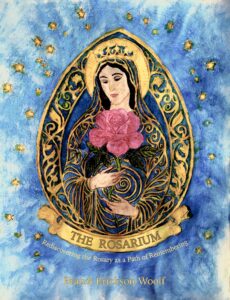 A return to prayer as a living body
For centuries, the rosary has been held inside the structure of the Church, shaped by doctrine, guarded in a way that suggests there is a correct way to approach it – and by extension, a correct kind of person to practice it.
If you’ve ever held the beads, or even just felt drawn to them from a distance, you may have sensed that there was something there beyond the words you were taught – or never quite learned how to enter. Something rhythmic, almost like muscle memory.
And yet, for many of us, the way it’s been handed down makes it difficult to access. The structure can feel rigid. The prayers can feel external. The mysteries can seem like stories you’re supposed to accept without question, rather than experiences you’re allowed to move through.
Sometimes the hesitation is shaped by real rupture – experiences that make it impossible to approach anything that feels like inherited authority.
So the practice stays at the edge, just out of reach.
The Rosarium was written for that threshold – for the moment when something in you recognizes the shape of the rosary, but needs a different way in.
The rosary was never only doctrine.
It was rhythm. It was body.
Devotion as a circle you can hold.
And like so many sacred things… it was contained.
66 pages with a lasting presence – something you don’t rush through, but return to, revisit, and gradually begin to live alongside. Rather than explaining the rosary from the outside, it opens a way of entering it from within your own body and awareness. The repetition becomes something you can settle into. The prayers begin to shift from language you recite into rhythm you inhabit.
Over time, the experience changes. What once felt distant starts to feel relational.
This is especially true in the way Mary is approached.
For many women, Mary has been flattened into something quiet, obedient, and unreachable. She has been an ideal to measure against, often stripped of complexity. That version of her has been repeated so consistently that it can be difficult to sense anything beyond it.
But if you stay with the practice long enough, if you let the rhythm do its work, she begins to take on dimension again. There is space for relationship, for curiosity, even for tension. Over time, that relationship becomes one of the most meaningful aspects of the practice.
And when that happens, the mysteries change too.
Annunciation, grief, surrender, transformation – these are not abstract concepts. They are patterns most of us have lived in some form, whether or not we’ve ever named them that way.
This is part of why the rosary has endured as long as it has. Beneath its formal structure, it carries something much older.
There are practices that inform you.
And there are practices that reshape you.
The Rosarium is a reclamation.
Long before doctrine fixed her in place, the sacred feminine moved through story in many forms.
If you’re someone who already works with myth or archetypal language, you may feel echoes of the descent and return of Inanna, or the devotion and re-membering carried by Isis.
The quiet, world-altering yes of Mary.
These stories emerge from different places, yet they move through similar terrain. Once you begin to feel that terrain in the rosary itself, the practice opens in a new way.
The Rosarium doesn’t ask you to adopt a belief system in order to access this. It doesn’t try to redefine it or claim authority over it. It simply offers a way to begin, and enough depth to keep unfolding as you continue.
It invites you to walk it consciously.
This is not about rejecting the traditional rosary.
It is about meeting it differently.
The Rosarium (Book) — $36
A 66-page devotional text that reintroduces the rosary as an embodied, mystical practice.
Written to be read slowly, returned to, and lived with.
The Companion Guide — $20
A practical and experiential counterpart to the book.
Prompts, reflections, and gentle structures to help you actually practice rather than just understand.
The Bundle — $50
For those who want both the transmission and the integration.
(all text comes in a downloadable pdf format)
What You’ll Experience
- A way into the rosary that does not require you to override your intuition
- A relationship with Mary that feels personal, alive, and evolving
- A deeper understanding of the mysteries as inner experiences – not distant stories
- A rhythmic prayer practice that can hold you in times of grief, transition, or longing
- Alternative prayers and mysteries to deepen and expand the practice
- A bridge between your existing spiritual practices and a lineage you may have felt shut out of
This is not a theological study. It is not about getting the prayers “right.”
It is a way of feeling your way into the rosary
as a living, breathing devotional practice.
Here, the mysteries are not events to memorize –
they are thresholds to enter.
Mary is not distant, silent, or one-dimensional –
she becomes a presence you can actually relate to, question, walk beside.
And the repetition of prayer is not obligation –
it becomes rhythm, mantra, a kind of sacred unraveling.
This Is For You If…
- You feel drawn to the rosary, but traditional approaches feel inaccessible or empty
- You have stepped outside of traditional religious structures and still long for devotional rhythm
- You are a mystic, a seeker, a practitioner of ritual who wants something deeper than surface practice
- You are curious about Mary – not as she was presented to you, but as she might actually be encountered
- You are looking for a practice that can hold you through change, grief, or transition
- You are ready to engage prayer as something that changes you, not something you perform
Choose Your Path
Written by a human. No AI.